Five Ways to Lose Your Fantasy Football League this Season
And the five mental models to help you avoid each mistake.
By: Philip “Flip” O’Toole, CIMA®
My Fantasy Football League – An Origin Story (200)
I became commissioner of my first fantasy football league in 1996. Before dedicated websites, apps and smartphones, it was the equivalent of a part-time job.
Every Monday morning, I grabbed the newspaper, worked my way through the box scores and manually entered every player’s statistics into a Lotus 1-2-3 spreadsheet. All transactions, including starting lineups, trades, and waiver wire were made via email.
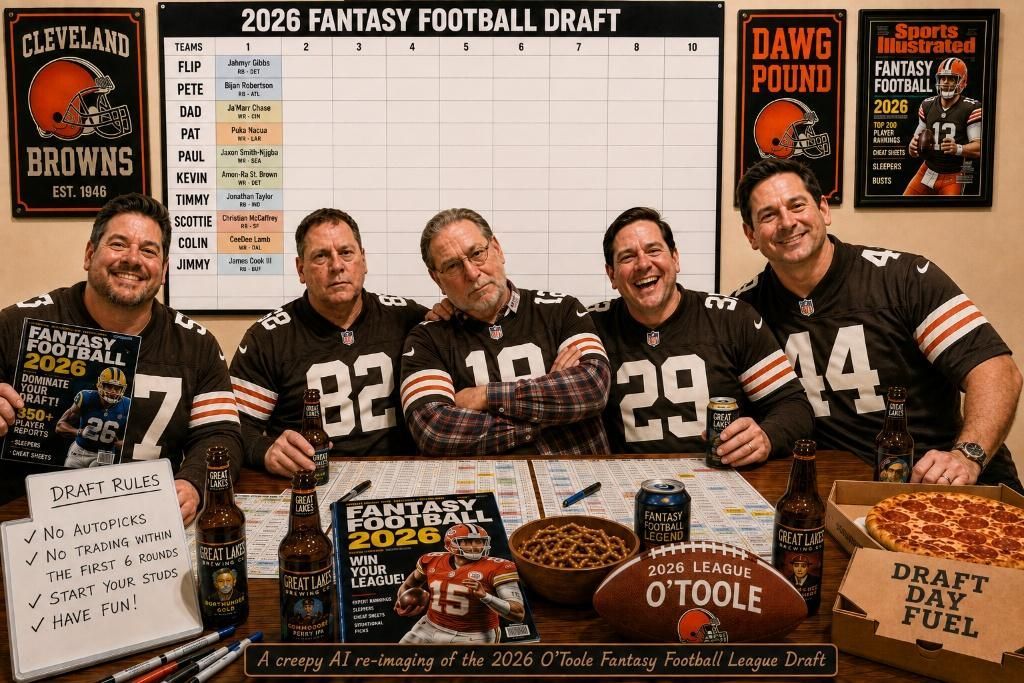
The best part of fantasy football in 1996 was, because technology was so primitive, the drafts had to take place in person. It was an excuse for a group of 10 buddies to get together, share pizza and beer, and play the role of General Manager of fake football teams with clever names like Favre From Over and Rice Rice Baby.
What has changed most about running a fantasy football league over the last 30 years is technology. Today, a person can manage a dozen fantasy football leagues with no problem.
What hasn’t changed is owner behavior when it comes to the draft, rosters, and starting lineups. Today, the biggest impediment to winning a fantasy football league is the same as it was in 1996.
The biggest obstacle wasn’t necessarily the other nine owners. It was – and still is - ourselves.
Mistake #1: Falling in Love with Your First-Round Pick (aka Anchoring)
Imagine spending the fourth overall pick on the consensus second best overall wide receiver. Unfortunately, his quarterbacks end up throwing more interceptions than touchdowns, and he ends up finishing outside the top 20 WRs for the season.
This happened to every fantasy team owner who selected Justin Jefferson of the Minnesota Vikings near the top of the first round in 2025. And despite the circumstances, some continued to count on him to lead their team each week. Why?
In behavioral psychology, this is “anchoring”, the tendency to rely disproportionately on earlier pieces of information over current information. In this case, many were anchored to the player’s projection coming into the draft and the fact he was drafted so high. That original information can outweigh the new evidence suggesting our expectations should change.
What can you do about it?
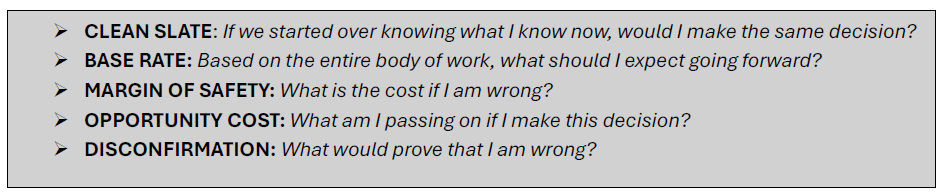
One possible antidote to anchoring is the Clean Slate Test. Instead of saying “I cannot bench my first-round pick”, ask yourself:
“If we started over knowing what I now know, would I make the same decision?”
It forces you to make a new assessment of the situation based on current information.
If the answer to the above question is “no”, then perhaps it is time to change your depth chart.
Mistake #2: Chasing Last Week’s Points (aka Recency Bias)
Now imagine it is the end of week three. Your team has lost all three games, and your first-round superstar is not helping.
What do you do?
Many fantasy owners last season selected undrafted Tre Tucker of the Las Vegas Raiders off the waiver wire and cut one of their draft picks.
Why?
Despite having little production in two plus seasons, Tucker went off in week three leading most fantasy leagues in scoring for the week. Many quickly added him to their roster.
Behavioral psychologists call this recency bias, the tendency to overvalue the most recent information while ignoring older historical data.
How to avoid recency bias?
One potential mental model that works well is base-rate thinking. In other words, do not focus on what happened most recently, instead ask yourself:
“Based on the entire body of work, what should I expect going forward?”
This encourages people to zoom out and examine a full history as opposed to hyper-focusing on what happened most recently.
If the answer to the above question is “not much”, then maybe consider hanging onto all 12 of your draft picks instead of risking losing one to another team.
Mistake #3: The Smartest Guy in the Room (aka Overconfidence Bias)
Every fantasy league has one person who thinks they know more than everybody else. And if you don’t know who that person is in your league, well…
This is the owner who drafts a projected lower-round pick earlier than expected. Just often enough they are correct, making them an even greater danger to themselves the following season.
This bias is known as overconfidence, the tendency to overestimate our own knowledge, judgement, and ability to predict an uncertain future. The risk of overconfidence is that success depends upon bold predictions coming true.
What can we do to combat overconfidence bias?
Margin of safety is a mental model popularized by Benjamin Graham. It simply means giving yourself some room to be wrong.
If you have a 3rd round grade on a projected 8th round pick, do not take him in the 3rd round. If you are wrong, the risk is too great. Instead ask yourself:
“What is the cost if I am wrong?”
If the answer to the question is “being wrong with my third round pick could cost me a championship” then perhaps you should build in a margin of safety and wait until the 6th or 7th round to make this pick.
Mistake #4: Home Team Heroes (aka Familiarity Bias)
As a lifelong Browns fan, I know more about Cleveland’s third string running back than I do about half the starting RBs in the league.
And because Cleveland is a football town first, the amount of content available to Browns fans daily is overwhelming. This is true with many fantasy footballers when it comes to their hometown players.
Because my league is loaded with Clevelanders, I already know a couple of Browns rookie WRs will go much higher in our draft than leagues based in other cities.
This is familiarity bias, the tendency to favor what we know simply because we know it better.
So, what can we do to combat this bias?
One mental model used to combat familiarity bias is opportunity cost. It forces people to make the familiar compete on equal terms with the less familiar.
Instead of saying “I am taking Concepcion or Boston early because I believe they will have a breakout rookie season”, ask yourself:
“What am I passing on if I make this decision?”
If the answer is “a top 20 WR from 2025” then perhaps resisting the urge to take a hometown hero too early is the prudent path forward.
Mistake #5: Tunnel Vision (aka Confirmation Bias)
This is probably the most difficult bias to overcome. Imagine you were able to draft the same player this season who was a driving force behind your championship last season.
You not only believe this player can be dominant, you experienced it firsthand. But for whatever reason, that dominance doesn’t show up this season.
Instead of seeking out evidence that challenges your original belief, you only seek out evidence that supports what you already believe to be true. The schedule has been brutal. The offensive line was hurt. The coaches haven’t adjusted yet. Just wait until next week.
Or perhaps the uncomfortable truth is that last year was an outlier.
What can you do?
Disconfirmation is another mental model used successfully by Warren Buffett and Charlie Munger that can be a defense against confirmation bias. It works by attacking your own beliefs. Instead of looking for all the reasons that you are right, ask yourself:
“What would prove that I am wrong?"
Strong opinions can be useful. The willingness to abandon them is even more valuable.
The longer you hang onto your belief that this player will lead you to another championship, the more your chances decrease. By contrast, the sooner you recognize the situation for what it is, the sooner you can pivot and try to redirect your season.
How Fantasy Football Can Be Like Wealth Management
The consequences of making these mistakes during a fantasy football season are minimal. Losing results in ridicule from the rest of the league, missing out on a little prize money, and potentially being subject to an embarrassing punishment for finishing last.
The point is that human biases and decision-making do not change as the stakes are increased.
When it comes to wealth management, we sometimes:
➢Anchor ourselves to a retirement age chosen years ago.
➢Allow recent market performance to alter long-term plans.
➢Become overconfident about how much we will earn, save or need in retirement.
➢Gravitate toward the familiar like a concentrated position in company stock.
➢Look for evidence to confirm choices already made about retirement, Social Security or other financial decisions.
The parallels are hard to ignore.
Fantasy football owners have access to more information than ever before. Heck, we can even have AI draft our teams for us. Times have certainly changed from the days of transcribing stats from the newspaper into a spreadsheet.
Yet more information has not eliminated bad decisions. Sometimes it simply gives us more evidence to support what we already believe or more information from which to become overwhelmed.
How we act on information is most important. Mental models can help, but like in fantasy football, oftentimes our biggest opponent in managing wealth is overcoming ourselves.
Process over Predictions
A good fantasy football decision can still produce a bad result. And we can occasionally get lucky with a bad decision. Wealth Management works much the same way.
We cannot control markets, tax laws, interest rates, inflation, or how long we live. What we can control is the process to help us make the best decisions when the future is uncertain.
That means recognizing our biases, challenging our assumptions and being willing to change our minds when the evidence changes.
Because whether we are managing a fantasy football team or our family’s financial future, one of the most important variables is still within our control: our behavior.
The views and opinions expressed herein are those of the author(s) noted and may or may not represent the views of Lincoln Investment. These views are as of July 16, 2026 and are subject to change based on subsequent developments. The material presented is provided for informational purposes only. Information is based on sources believed to be reliable; however, their accuracy or completeness cannot be guaranteed. Nothing contained herein should be construed as a recommendation to buy or sell any securities. As with all investments, past performance is no guarantee of future results. No person or system can predict the market. All investments are subject to risk, including the risk of principal loss.